 Strategy · Growth
Identifying Your #1 Business Constraint (And Why Fixing Anything Else Is a Waste)
In This Article
Picture a garden hose running full blast — until there's one kink in the line. It doesn't matter how hard you crank the spigot, how new the hose is, or how good the nozzle is. That one kink decides how much water comes out the end. You could replace everything else on the hose and get not a single extra drop. Fix the kink, and the water roars back.
Your business works exactly the same way. At any given moment, there is one thing — and only one — that's capping how much it can grow. A chain is only as strong as its weakest link; pour effort into the strong links and the chain holds at exactly the same weight. This is the Theory of Constraints, and it's the single most important idea most local business owners have never been taught. Once you see your business as a system with one bottleneck at a time, you stop wasting money on the wrong fixes and start moving the needle on purpose.
Your business has exactly one bottleneck right now
Here's what trips owners up: a business has dozens of things that could be better. The website's a little dated. The ads could be sharper. The follow-up is sloppy. Retention isn't great. All true — and all a trap. Because if you try to improve all of them at once, you spread your money and attention so thin that nothing improves enough to matter. Everything gets 10% better and the business doesn't move.
The Theory of Constraints says something blunt: at any moment, one of those weak spots is the binding constraint — the one actually holding the whole system back. Improving anything that isn't the constraint produces close to zero result, because the bottleneck still caps the output downstream. It's not that the other problems aren't real. It's that fixing them right now is wasted motion.
This is why two shops doing identical revenue can have wildly different next moves. One needs leads. One is drowning in leads but can't close them. One closes fine but customers vanish after a single visit. Same revenue, completely different constraint — and the owner who pours money into the wrong one lights it on fire. The whole game is identifying which single link is the weak one today, fixing only that, and then asking the question again.

The constraint lives in one of four stages
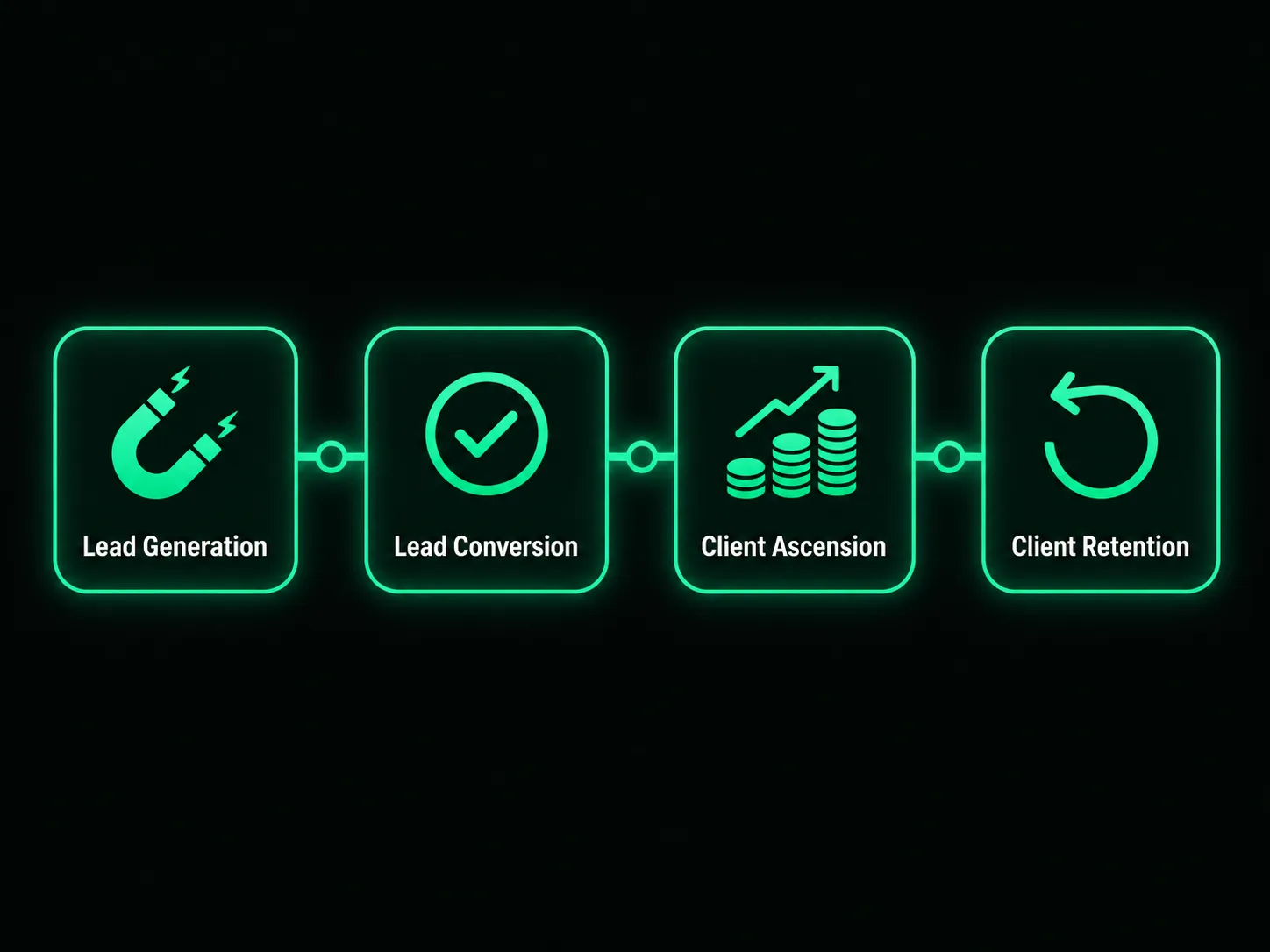
Your constraint isn't floating somewhere abstract. It's sitting in a specific spot in your customer journey, and that journey only has four stages. Every dollar a business ever makes has to flow through all four, in order:
- Lead Generation — strangers become leads. Do enough of the right people even know you exist?
- Lead Conversion — leads become paying customers. When people show up, do they actually book or buy?
- Client Ascension & Fulfillment — customers spend more, and you can deliver it. Do they buy bigger, more often — and can you handle it?
- Client Retention — customers come back. Do they stick around, or is it a one-and-done revolving door?
Your constraint is in one of these four. That's it. The job is to walk through each stage, look at the symptom, ask a few honest diagnostic questions, and find the one that's badly underperforming. Below, each stage gets the same treatment: what it is, the symptom that screams "this is your constraint," the questions that confirm it, a local example, and the kind of fix that clears it.
Lead Generation — not enough people know you exist
What it is: The top of the funnel. The flow of new strangers turning into leads — phone calls, form fills, walk-ins, booked consults. If too few people enter here, nothing downstream can save you. You can't convert, ascend, or retain a customer you never got.
The symptom that says THIS is your constraint: Your conversion is fine, customers are happy, they come back — but the calendar has holes and the phone is quiet. You're good at turning leads into customers; you just don't have enough leads coming in.
Diagnostic questions:
- How many new leads (calls, forms, walk-ins) did you get last month? Is that number flat or shrinking?
- When a lead does come in, do you usually close it? (If yes, your problem is upstream — volume, not skill.)
- Where does your traffic actually come from — and would it survive if your one referral source dried up?
- If you doubled your leads tomorrow, could you handle them? (If yes, leads really are the ceiling.)
Local example: A mobile dent-repair guy closes 70% of everyone who calls and his reviews are glowing — but he only gets five calls a week. He doesn't have a sales problem or a service problem. He has a visibility problem. Almost nobody in town knows he exists.
The kind of fix: Turn up the top of the funnel — a Google Business Profile that actually ranks, local SEO, reviews, paid ads, a referral system. The goal is more qualified strangers entering the journey. Just be sure leads are genuinely the constraint first, because this is also the most expensive stage to throw money at.
Lead Conversion — leads come but don't book or buy
What it is: The moment of truth where interest becomes money. Visitors who book, callers who buy, quotes that turn into signed jobs. Conversion is a multiplier on everything above it — and the most common place the real constraint hides while owners blame everything else.
The symptom that says THIS is your constraint: Plenty of people are finding you — decent traffic, ringing phone, lots of quotes going out — but the customers-per-lead is thin. Leads come in the top and quietly leak out without buying.
Diagnostic questions:
- Of everyone who visits your site or calls, what percent actually book or buy? (Under 2–3% on a service site is a red flag.)
- How fast do you respond to a new lead? Minutes, or hours? (Speed-to-lead quietly kills conversion.)
- Is your offer clear and your pricing obvious, or do people have to work to figure out what to do next?
- How many quotes turn into jobs — and do you ever follow up with the ones who don't reply?
Local example: A salon's site gets 1,000 visitors a month and only 10 book — a 1% conversion rate. The owner's instinct is to buy more ads. But pouring traffic into a page that converts at 1% just means paying more to lose more people. The real fix is free: a clearer offer, an online booking button above the fold, and faster replies. Lift that page to 3% and she triples her customers without spending another dollar on traffic.
The kind of fix: Sharpen the offer, simplify the booking path, respond faster, add proof (reviews, photos, guarantees), and build a dead-simple follow-up for leads who don't buy the first time. Conversion is usually the cheapest, highest-leverage fix you have.
This is the most expensive mistake in the whole funnel: buying more leads when conversion is the constraint. If your page converts at 2%, doubling your ad spend doubles your cost and barely moves your sales. Fix the leak before you turn up the tap.
Client Ascension & Fulfillment — they buy, but never buy more (or you can't deliver more)
What it is: Two sides of the same stage. Ascension is whether customers spend more over time — bigger tickets, add-ons, packages, higher-value services. Fulfillment is whether you can actually deliver more without the whole thing falling apart. This stage is where margin and capacity live.
The symptom that says THIS is your constraint: You've got plenty of customers and they convert fine — but the average ticket is small, nobody buys up, and revenue feels capped. Or the opposite: demand is there but you physically can't take on more work without quality slipping.
Diagnostic questions:
- What's your average order value — and when did you last try to raise it with an add-on, package, or price increase?
- Do you have a clear next thing to sell someone after their first purchase, or does the relationship just stop?
- Are you turning away work, booked out for weeks, or watching quality slip because you're maxed out?
- Do your best customers even know about your higher-value services?
Local example: A lawn-care company signs customers easily and keeps them — but every customer only buys the $40 weekly mow. They never get offered fertilization, aeration, leaf cleanup, or a snow-removal contract. The owner is leaving thousands per customer on the table. The constraint isn't leads or conversion; it's that nobody is ascending the customers they already have. (On the other side: a contractor so booked he turns away $200K a year because he can't deliver more — his constraint is fulfillment capacity, and more leads would only make it worse.)
The kind of fix: Build an ascension path — add-ons, bundles, tiers, recurring plans — and actually offer it. Raise prices where the value supports it. On the fulfillment side, fix capacity: hire, systematize, or productize so you can deliver more without breaking. (For the numbers behind this stage, see our Know Your Numbers guide on AOV and lifetime value.)
Client Retention — customers leave and don't come back
What it is: The bottom of the funnel and the secret engine of every healthy business. Retention is whether customers come back and buy again. It's the difference between a treadmill — constantly chasing new customers to replace the ones bleeding out the back — and a flywheel that compounds.
The symptom that says THIS is your constraint: You generate leads, you convert them, they spend decently — but they don't come back. You're working hard to fill the top of the bucket while it pours out a hole in the bottom. Revenue feels like running to stand still.
Diagnostic questions:
- What percent of customers came back at least once in the last year? (Under 40–50% for a repeat-business is a leak.)
- Do you have any system to bring people back — texts, reminders, a loyalty offer, a recurring plan?
- How many of last year's customers have you simply never heard from again?
- If a customer had a bad experience, would you even know — or would they just quietly disappear?
Local example: A dental office gets new patients in the door fine, but only 30% come back for their six-month cleaning. Every lost patient is worth thousands over the years they would have stayed. No amount of new-patient advertising fixes this — you're filling a bucket with a hole in it. The constraint is purely retention.
The kind of fix: Build the back end — automated reminders, follow-up texts, a rebooking system at checkout, a loyalty or membership program, and a way to catch unhappy customers before they ghost. Because you've already paid to acquire these people, every repeat visit is almost pure profit — which is why retention quietly powers your whole lifetime value.
How to actually find YOUR constraint
Enough theory. Here's the walk-through. You're going to lay your funnel out stage by stage, put a number on each one, and find the first stage that's badly out of line. That stage is your constraint. You don't need fancy software — you need the numbers you already have and an honest hour.
Go down the funnel in order and write the number next to each stage:
- Lead Generation: How many new leads came in last month? Is it enough to hit your goal, or are there obvious holes in the calendar?
- Lead Conversion: Of those leads, what percent became paying customers? (Under ~2–3% on a service site, or a low quote-to-job rate, is a flashing light.)
- Ascension & Fulfillment: What's your average order value, and do customers ever buy more? Are you capped on capacity?
- Retention: What percent of customers came back? (Under ~40% for a repeat-purchase business is a leak.)
Now find the first stage that's badly underperforming a healthy benchmark. That's your constraint. Usually it jumps off the page the second it's written down. A business with 1,000 visitors and a 1% conversion rate doesn't have a traffic problem — the conversion number is screaming. A business that converts great but retains 30% doesn't need more ads — retention is the obvious leak.
This is exactly why knowing your numbers matters. Your funnel metrics don't just describe your business — they point straight at the constraint. If you haven't put numbers on these stages yet, start with our Know Your Numbers guide; those seven metrics are the readout that tells you which link is weak. And if you can't even see your conversion rate because nothing's tracked, that's step zero — see how to track website traffic first.
Always work the funnel top to bottom. The first stage that's broken is your constraint, even if a lower stage looks worse on paper — because a downstream fix can't help customers who never made it that far. Fix the earliest weak link first.

Fix it, re-measure, then repeat
Here's the part that turns this from a one-time exercise into a growth machine: the constraint moves. The moment you fix your current bottleneck, a different stage becomes the new weakest link and inherits the title. This is a loop, not a project.
Watch how it cascades for that salon from earlier:
- Round 1 — the constraint is conversion. She lifts her booking page from 1% to 3%. Customers triple from the same traffic. Win.
- Round 2 — now leads become the constraint. Her page converts great, so suddenly the ceiling is that she only gets 1,000 visitors. Now spending on ads and local SEO makes sense — it didn't before. Win.
- Round 3 — now retention becomes the constraint. She's converting and getting traffic, but clients only come once. She adds rebooking-at-checkout and reminder texts. Repeat visits climb. Win.
Notice that buying ads — the thing she almost did first — was the right move in Round 2 and the wrong move in Round 1. Same action, opposite result, depending on where the constraint was. That's the whole point. The action isn't good or bad in a vacuum; it's only good if it's aimed at the current constraint.
So the discipline is simple: find it, fix it, re-measure, repeat. Pour everything into the one weak link until it's no longer the weakest. Then re-run the numbers, find the new constraint, and do it again. Re-check after any major change and at least monthly. Do this for a year and you won't recognize the business — not because you worked harder, but because every ounce of effort landed exactly where it mattered.
Frequently Asked Questions
A constraint is the single biggest bottleneck holding your business back right now — the one weak link that caps how much you can grow no matter how hard you work everywhere else. It usually lives in one of four stages of the customer journey: lead generation, lead conversion, client ascension, or client retention. Whichever stage is performing worst relative to the rest is your constraint, and it's the only thing worth fixing until it's no longer the weakest link.
Walk your funnel one stage at a time and look at the numbers. How many leads come in? What percent of them book or buy? Do customers spend more over time or just once? Do they come back? The first stage where the number is badly out of line with a healthy benchmark is your constraint. Often it's painfully obvious once it's written down — a business with plenty of traffic but a 1% conversion rate doesn't have a traffic problem, it has a conversion problem.
Your business has plenty of weak spots, but only one is the true constraint at any given moment — the one that's limiting growth the most right now. That's the point of the whole approach: stop trying to fix everything and put all your energy on the single weakest link. The others are real, but improving them won't move the business until the binding constraint is cleared, because the bottleneck caps the whole system.
No — that's the most common and most expensive mistake. Spreading your money, time, and attention across all four stages at once means everything improves a little and nothing improves enough to matter. Worse, you usually end up investing in the stages that aren't the problem, like buying more ads when your real issue is that leads aren't converting. Pour everything into the one constraint, clear it, then move to the next one the numbers reveal.
More leads is only good if leads are your constraint. If your problem is a 2% conversion rate, pouring more traffic into a page or a phone line that can't close just means you pay more to lose more people. You double your ad spend and your sales barely move — because the bottleneck downstream caps everything. Fix the conversion first and the leads you already have suddenly produce more customers at no extra cost.
It moves every time you fix one. The moment you clear your current bottleneck, a different stage becomes the weakest link and inherits the title of constraint. Fix conversion and suddenly your real ceiling is that customers only buy once — now retention is the constraint. That's why this is a loop, not a one-time project: find it, fix it, re-measure, repeat. Re-check your numbers monthly or after any major change so you're always working the link that's actually holding you back.