 Strategy · Finance
Know Your Numbers: The 7 Metrics Every Business Owner Must Track
In This Article
Most business owners can tell you, to the dollar, what their truck payment is. Ask them what it costs to get one new customer, or what that customer is worth over the next four years, and you get a shrug. That gap is where money quietly leaks out of the business — month after month, year after year.
You don't need an MBA or accounting software to fix it. You need seven numbers, a calculator, and an afternoon. Once you know them, you stop guessing and start making decisions like the operator of a real business instead of someone hoping it works out. This guide walks through every one in plain English: what it means, how to calculate it, a real local-business example with actual numbers, and — most important — the decision each one lets you make.
Why "knowing your numbers" is the real moat
Here's the uncomfortable truth: two businesses can do the same revenue and one quietly goes broke while the other compounds. The difference isn't effort. It's that one owner knows whether each customer is profitable, whether their marketing is paying for itself, and where the leak is — and the other is flying blind and calling it "being busy."
When you know your numbers, three things happen. You stop wasting money on marketing that doesn't pay back. You start spending more confidently on the marketing that does, because you can prove it works. And you make every decision — pricing, hiring, ad budget, which service to push — based on what the math says instead of what your gut feels at 11pm. Let's get you those numbers.

Average Order Value (AOV)
What it is: The average amount a customer spends in a single transaction. It's the simplest number on this list and the foundation for almost every other one.
The formula:
Local example: A salon books $40,000 in sales over a month across 500 visits. AOV = $40,000 ÷ 500 = $80 per visit. That's the average a client spends every time they sit in the chair.
Why it matters: AOV is the easiest lever to pull because the customer is already buying. Raising it 10% — through a package, an add-on, or a small price increase — drops almost straight to your bottom line. You already paid to get them in the door; you might as well make the visit worth more.
The decision it unlocks: Should you upsell, bundle, or raise prices? If your AOV is $80, an add-on service worth $20 lifts it to $100 — a 25% revenue increase with zero new customers. AOV tells you exactly how much headroom you have.
Customer Lifetime Value (LTV)
What it is: The total profit a single customer brings you over the entire time they do business with you — not just one sale, their whole relationship with you. This is the number that changes how much you're willing to spend to get a customer.
The formula:
Local example: Take that salon. AOV is $80. The average client comes 6 times a year and stays a customer for 4 years. Gross margin is 60%.
LTV = $80 × 6 × 4 × 0.60 = $1,152 in lifetime gross profit. That single client walking in for a $80 haircut is actually worth over a thousand dollars to the business. (Skip the margin and you get $1,920 in lifetime revenue — useful, but the profit number is the one that governs your decisions.)
Why it matters: Owners chase one-off sales because that's what they can see. LTV reveals the real prize. When you know a client is worth $1,152, missing one to a rude front desk or a missed call isn't an $80 loss — it's an $1,152 loss. It reframes everything about service and follow-up.
The decision it unlocks: How much can you afford to spend to acquire a customer? If each one is worth $1,152 in profit, spending $120 to get one is a bargain. Without LTV, that $120 looks expensive. With it, you'd happily spend it all day.
Customer Acquisition Cost (CAC)
What it is: What it costs you, on average, to win one new customer. Every dollar you spend on ads, your website, promotions, and the time you put into marketing — divided by how many new customers that effort produced.
The formula:
Local example: The salon spends $3,000 in a month — $2,400 on Google and Meta ads, $600 on a promo — and that brings in 25 new clients. CAC = $3,000 ÷ 25 = $120 per new customer.
Why it matters: CAC is the number most owners never calculate, and it's the one that quietly bankrupts businesses. If you're paying $120 to acquire a customer who only ever spends $80 once and never comes back, you're losing money on growth — and the more you "grow," the faster you go broke. CAC tells you whether your marketing is an investment or a leak.
The decision it unlocks: Which marketing channels to scale and which to kill. Calculate CAC per channel. If Google brings customers at $90 and that flyer campaign brings them at $300, you don't need a meeting — you need to move the budget to Google.
Track CAC per channel, not just overall. A blended CAC hides the fact that one channel is carrying your winners and another is bleeding you dry. The averages lie; the per-channel numbers tell the truth.
The LTV:CAC Ratio
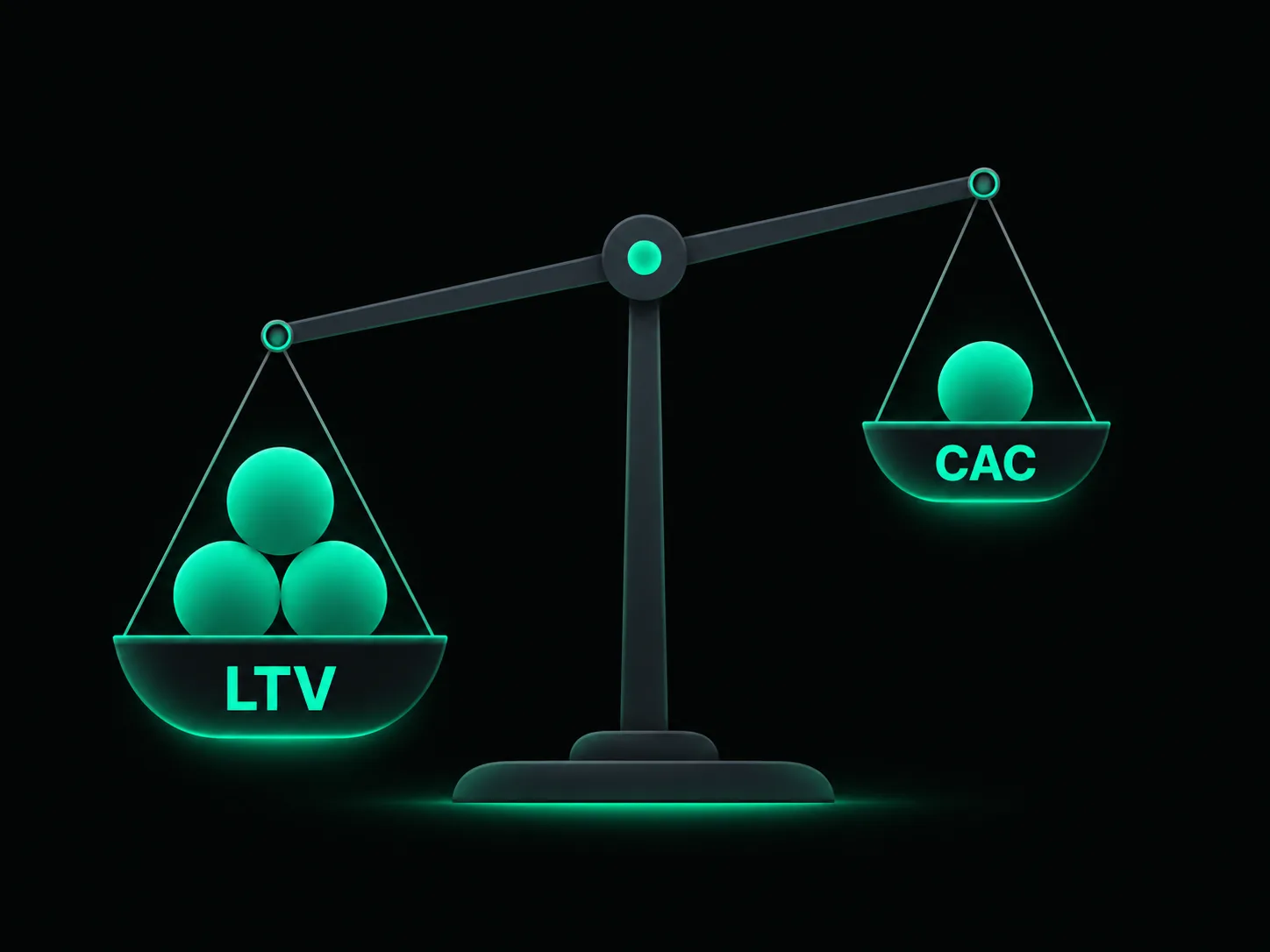
What it is: The single most important number in your business. It compares what a customer is worth (LTV) to what they cost to acquire (CAC). It tells you, in one figure, whether your entire business model actually works.
The formula:
Local example: The salon's LTV is $1,152 and its CAC is $120. Ratio = $1,152 ÷ $120 = 9.6:1. For every dollar spent acquiring a client, the business gets $9.60 in lifetime gross profit back. That's an outstanding, scalable machine.
Why it matters: This is your business's truth serum.
- Below 1:1 — you lose money on every customer. Stop and fix this now.
- Around 3:1 — healthy. This is the benchmark to aim for.
- 5:1 and above — strong economics, but it can also mean you're underspending on marketing and leaving growth on the table.
The decision it unlocks: Whether to step on the gas or pump the brakes. A 9.6:1 ratio like the salon's is a flashing green light — it can afford to spend much more aggressively to acquire customers and still print profit. A 2:1 ratio says fix your margins, retention, or acquisition cost before you scale, or you'll just scale a leak.
A sky-high ratio isn't always a trophy. If you're at 10:1 and starving for customers, you're being too cautious — you could spend more to acquire and still come out way ahead. The goal is healthy, sustainable growth, not the highest possible number on a spreadsheet.
Gross Margin
What it is: The percentage of each sale you keep after paying the direct cost of delivering it — the product, the materials, the direct labor on that job. It's the difference between revenue and profit, and it's the number that decides whether being "busy" actually makes you money.
The formula:
Local example: The salon charges $80 for a service. The product used, the booth rent allocated, and the direct labor cost $32. Gross margin = ($80 − $32) ÷ $80 = $48 ÷ $80 = 60%. Of every $80 ticket, $48 is gross profit before overhead like rent and admin.
Why it matters: Margin quietly decides everything. A business doing $1M at a 20% margin keeps less than one doing $400K at a 60% margin. Two owners can brag about the same revenue while one is wealthy and one is drowning. Margin is also what funds your acquisition budget — thin margins mean you can't afford to spend much to get customers, which chokes growth.
The decision it unlocks: What you can charge, what you can afford to spend on acquisition, and which services to push. Low-margin services that keep you "busy" can be quietly bleeding you. Margin tells you which work to chase and which to fire.
Conversion Rate
What it is: The percentage of people who take the action you want out of everyone who had the chance to. It can be website visitors who book, callers who buy, or quotes that turn into jobs. It measures how good you are at turning interest into customers.
The formula:
Local example: The salon's website gets 1,000 visitors a month and 30 of them book online. Conversion rate = (30 ÷ 1,000) × 100 = 3%. For a contractor: if 40 quotes a month turn into 16 signed jobs, that's a 40% close rate.
Why it matters: Conversion rate is a multiplier on everything upstream. If you double your website conversion from 3% to 6%, you just doubled your customers without spending another dollar on traffic. That also cuts your CAC in half and improves your LTV:CAC ratio. It's often the cheapest growth lever you have.
The decision it unlocks: Whether to spend on more traffic or fix what you've got. If you're sending 1,000 people to a site that converts at 1%, buying more traffic is pouring water into a leaky bucket. Fix the page, the offer, or the follow-up first — then turn the traffic up.
You can't improve a conversion rate you don't measure. If you don't have website analytics set up yet, that's step zero. See our guide on adding Google Analytics to your website.
Retention / Repeat Rate
What it is: The percentage of customers who come back and buy again. It's the difference between a business built on a treadmill of constantly chasing new customers and one that compounds on the customers it already has.
The formula:
Local example: The salon had 300 active clients at the start of the year, and 180 of them came back for another visit. Retention = (180 ÷ 300) × 100 = 60%.
Why it matters: Retention is the secret engine behind LTV. Every point of retention you gain extends how long customers stay and how many times they buy — which directly inflates lifetime value. It's also far cheaper to keep a customer than to acquire a new one; you've already paid the CAC, so every repeat visit is almost pure margin. A business with strong retention can outspend everyone on acquisition because each customer pays back so much more.
The decision it unlocks: Where to invest in the experience. If retention is low, no amount of new-customer marketing fixes the business — you're filling a bucket with a hole in it. Low retention says fix the product, the service, or the follow-up (texts, reminders, loyalty offers) before you pour more into the top of the funnel.
What these numbers tell you together
Here's where it clicks. These seven numbers aren't a checklist — they're a connected system, and once you see how they feed each other, you understand your whole business at a glance.
Start with the chain that builds lifetime value:
That's the engine. Raise AOV with bundles and add-ons. Raise frequency and lifespan with retention. Protect margin with pricing and smart service mix. Every one of those four levers makes the same customer worth more — and that compounds.
Then weigh it against what customers cost:
This is the verdict on your whole model. If your LTV:CAC is below 3:1, you're likely overpaying for customers — and the fix is rarely "just spend less on ads." More often it's raising LTV (better retention, higher AOV, healthier margin) so each customer can carry a higher acquisition cost. A business that retains well and sells with strong margins can afford to outbid every competitor for the same customer and still win.
And conversion rate sits underneath all of it. Improve conversion and you lower CAC automatically — fewer ad dollars per customer — which pushes the LTV:CAC ratio up without touching anything else. That's why conversion is so often the highest-leverage place to start.
Put it together and the story writes itself. A salon at $80 AOV, 6 visits a year, 4-year lifespan, 60% margin, $120 CAC, and 3% conversion isn't a collection of stats — it's a machine returning $9.60 for every dollar it spends to grow. The owner who knows that spends aggressively and wins. The one who doesn't leaves it all on the table.

How to start tracking this week
You don't need software or a bookkeeper to begin. Open a spreadsheet and pull the data you already have. Here's the order:
- Pull last month's revenue and order count from your point-of-sale or booking system. Divide them — that's your AOV.
- Estimate frequency, lifespan, and margin. How often does a typical customer buy in a year? How long do they stick around? What does each sale cost you to deliver? Use honest estimates — you'll refine them. Multiply it out for your LTV.
- Add up what you spent to get customers last month and divide by new customers won. That's your CAC — do it per channel if you can.
- Divide LTV by CAC. Now you have the one ratio that tells you whether to scale or fix.
- Note your conversion rate and retention from your analytics and your repeat-customer records.
Write these seven numbers down and date them. Next month, do it again. The trend is worth more than any single snapshot — and within a quarter you'll be making decisions with a clarity most of your competitors will never have.
Frequently Asked Questions
If you can only track one thing, track the ratio of customer lifetime value to customer acquisition cost (LTV:CAC). It tells you whether your whole business model works — whether each customer is worth more than what it costs to get them. A healthy local business runs at 3:1 or better. Everything else (AOV, retention, conversion rate) is a lever you pull to move that ratio.
The simple version: LTV = Average Order Value × Purchase Frequency per year × Average Customer Lifespan in years × Gross Margin. For example, a customer who spends $80 per visit, comes 6 times a year, stays 4 years, at a 60% margin is worth $80 × 6 × 4 × 0.60 = $1,152 in gross profit over their lifetime. If you skip margin, you get revenue LTV ($1,920) — useful, but profit LTV is the number that tells you what you can afford to spend to acquire them.
3:1 is the benchmark for a healthy business — every dollar spent acquiring a customer returns three dollars in lifetime gross profit. Below 3:1 you're likely overpaying for customers or your margins and retention are too thin. Above 5:1 isn't always a victory — it can mean you're underspending on marketing and leaving growth on the table. The goal is healthy, sustainable acquisition, not the highest possible ratio.
Check the fast-moving numbers — conversion rate, AOV, CAC — monthly. Check the slow-moving ones — LTV, retention rate, gross margin — quarterly, since they take months of data to mean anything. Looking daily creates noise, not insight. The discipline that matters is reviewing on a fixed schedule and writing the numbers down so you can see the trend, not the single data point.
No. You can calculate all seven of these metrics in a spreadsheet from data you already have — total sales, number of orders, what you spent on marketing, and your point-of-sale or booking records. Accounting software like QuickBooks makes pulling revenue and margin easier, and a CRM makes retention and repeat-rate easier to see, but none of it is required to start. Most owners can get their first set of numbers in an afternoon with a calculator.
Every one of these numbers works for service businesses — you just rename them. AOV becomes average ticket or average job value. Purchase frequency becomes how often a client books or returns. Gross margin is your revenue minus the direct labor and materials on each job. Retention is whether clients come back and whether they're on a recurring plan. A plumber, a salon, a dental office, and a law firm all live or die by these same seven numbers.