 Sales · The Zero-Cost Filter
Free Estimates Aren't Winning You Customers. They're Filtering In the Wrong Ones.
In This Article
Forty-five minutes. Imagine that's the last "just curious" estimate — the drive, the walkthrough, the measurements, the quote you typed up that evening instead of eating dinner with your family. You sent it. Then nothing. No "thanks, we'll think about it." No "went with someone else." Just silence, the same silence you've gotten used to from half the free estimates on your calendar.
Here's what almost no owner catches: that silence isn't a sales problem. It's not your price, your pitch, or your close. It's the sign on your ad that says the word "free" — and it's been quietly filtering your calendar for the wrong people since the day you started running it.
The Zero-Cost Filter

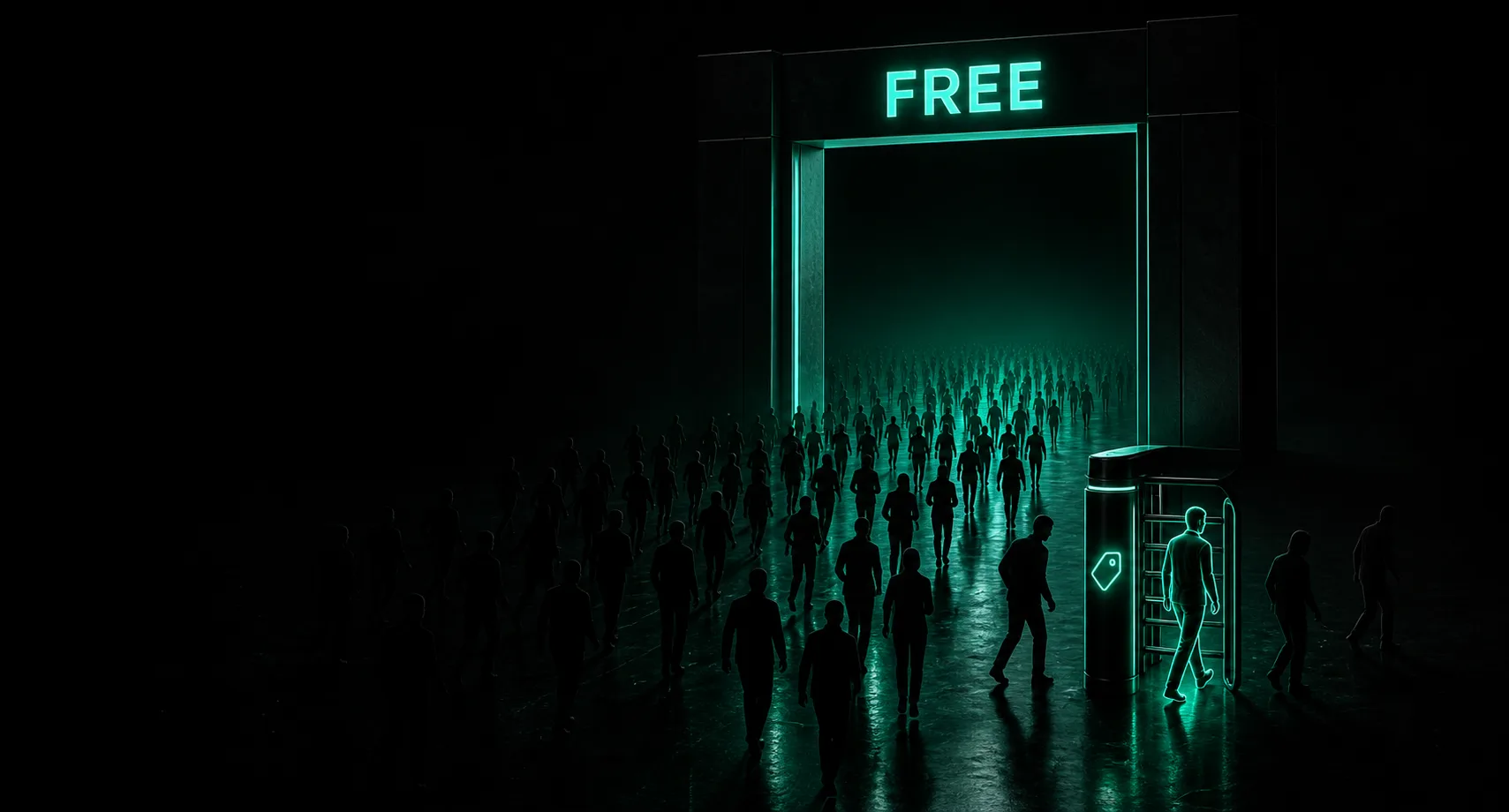
"Free estimate" feels generous. It isn't a filter at all — and that's exactly the problem. A gate with no cost to walk through it doesn't select for anything. Everyone who's mildly curious walks through the same door as everyone who's ready to hire, and from the other side of that door, they look identical: a name, a number, a job on your calendar.
You already know the type once you're standing in their kitchen. The tire kickers — the ones collecting three, four, five numbers before they've decided to do the job at all, sometimes before they've decided the job needs doing. Ask them what they're comparing against and the honest answer is usually "nothing yet." They're not buying. They're pricing. And "free" is the exact word that told them your business was a safe place to do that.
The tell shows up in the follow-up call, almost word for word: "can you do it for less?" Not "does this fix the problem," not "when can you start" — just the number, compared against numbers from businesses they've never met and will never remember. That's not a customer stalling on a decision. That's someone doing exactly what a free, no-commitment estimate trained them to do.
What this actually costs you
Every hour on a free estimate that goes nowhere is an hour that didn't go to a job that would have closed, and it doesn't show up anywhere on your books as a loss — it just shows up as a slow week that felt busy. Imagine your last twenty estimates. If even a third of them were price-shopping tire kickers who were never going to book anyone, that's not twenty estimates of selling — it's thirteen real conversations wearing a costume of twenty. Now imagine those seven wasted afternoons back on your calendar as diagnostic visits instead — even at $75 a visit, that's real money for hours you were already giving away for free.
It compounds in a second, uglier way. The price-shoppers who do bite are usually the same customers who'll push hardest for a discount later — and discounting is its own leak. Say your margin's 25%. A 12% discount there doesn't cost you 12% — it wipes out roughly 48% of the profit on that job, because the discount comes out of profit, not price. Run your own numbers in the Discount Cost Calculator — the free-estimate crowd and the discount-ask crowd are usually the same people, just at two different stages of costing you money.
The Paid Diagnostic

This isn't an argument that free offers are bad — GrowthLeaks' own free report works because it costs us almost nothing to produce and asks nothing of you but a few minutes. A free estimate is different: it costs you real windshield time and real labor to deliver, every single time, whether or not the person on the other end ever hires you. That's the distinction. When delivering the "free" thing costs you something real, free stops being generous and starts being a subsidy for people who were never going to pay you back.
The fix isn't complicated, and it isn't about raising your price. It's a small, named diagnostic or inspection fee — credited straight back if they book. The psychology here is the opposite of what most owners assume: a small cost doesn't repel real buyers. It repels everyone except real buyers. Someone with an actual, urgent problem barely notices a $49–$150 fee that comes off the final bill. Someone who was collecting five free numbers to compare notices it immediately, and quietly goes get a free one somewhere else — which is exactly the outcome you want.
Build it in 3 steps
Set a flat diagnostic fee
Pick a number that makes sense for your trade and what the visit involves — imagine somewhere in the $49–$150 range as a starting point, not a rule. It doesn't need to cover your full cost. It needs to be non-zero.
Credit it toward the job
If they book within your quoted window — say, 30 days — the diagnostic fee comes straight off the final invoice. A real buyer never feels like they paid twice; they feel like they paid a deposit.
State it once, plainly
"There's a $[X] diagnostic fee for the visit, credited toward the job if you move forward." No apology, no over-explaining. The moment you soften it like a mistake, it starts sounding like one. Say it the same way you'd say your hours — because it's a policy, not a negotiation. If you want the language for the number that comes right after, the Value-First Quote covers exactly how to present it.
"Won't I lose leads?"
Yes — and that's not the flaw in this plan, it's the entire point of it. You'll lose the callers who were never going to hire anyone this month, who were pricing three trades against each other for a project still living in a Pinterest board. Losing those "leads" doesn't cost you revenue, because they were never going to become revenue. What it costs you is the illusion of a full calendar.
What you keep is the customer worth protecting. Acquiring a new customer already costs 5 to 25 times more than keeping one you have, according to Harvard Business Review's analysis of the research on customer retention — which means the calendar hours you spend chasing price-shoppers aren't just wasted, they're hours stolen from actually serving the people already worth 5–25x more to your business. Every hour freed up by a lighter tire-kicker load is an hour you can put toward the customers already paying you instead of the ones who never will.
Pull your last ten free estimates. How many turned into a booked job? If it's fewer than half, ask what those other estimates had in common besides "free." Most owners find the same word every time: "just getting some numbers."
Imagine your calendar three months from now: every diagnostic slot filled by someone who already decided to hire someone, walking in having already paid a small, credited fee that proved it. Now picture this month instead — a full calendar of free walkthroughs, half of them ghosts by Friday, and you still don't know which half until you've already spent the gas money finding out. Both calendars take the same number of hours. Only one of them turns into invoices.
You can write the new policy on your next quote today — it costs nothing but the sentence. Or: want a second set of eyes on how your site and your ads are training people to price-shop you before they've even called?
Frequently Asked Questions
For anything beyond a two-minute look, yes — a small diagnostic or inspection fee is worth charging. It doesn't repel real buyers; it filters out the people who are collecting numbers to compare, not deciding who to hire. If your estimate takes real windshield time, materials assessment, or a scheduled visit, that time has a cost whether or not you charge for it.
There's no universal number — imagine a range like $49 to $150 depending on your trade and what the visit actually involves. The amount matters less than two things: it's non-zero, and it's credited toward the job if they book within a set window, so a real buyer never feels like they paid twice.
It will lose you some callers — the ones who were comparing free quotes from five businesses, not deciding who to hire. That's the point, not the cost. A real buyer with a real problem rarely blinks at a small fee that comes off the final bill; the ones who do blink were never going to book you anyway.
A free estimate is a number with nothing attached to it, open to anyone who calls. A paid diagnostic is a small, credited fee that only someone with a real, urgent problem will pay — which means every diagnostic on your calendar is someone who already decided you're worth their time, not just their curiosity.
Change what it costs to get a number from you. Price-shoppers are optimizing for zero-cost information — a free estimate is exactly that. The moment getting a quote requires even a small, refundable-on-booking commitment, the people who were never going to buy self-select out, and you're left talking to the ones who were.