How to Rank Higher on Google Maps
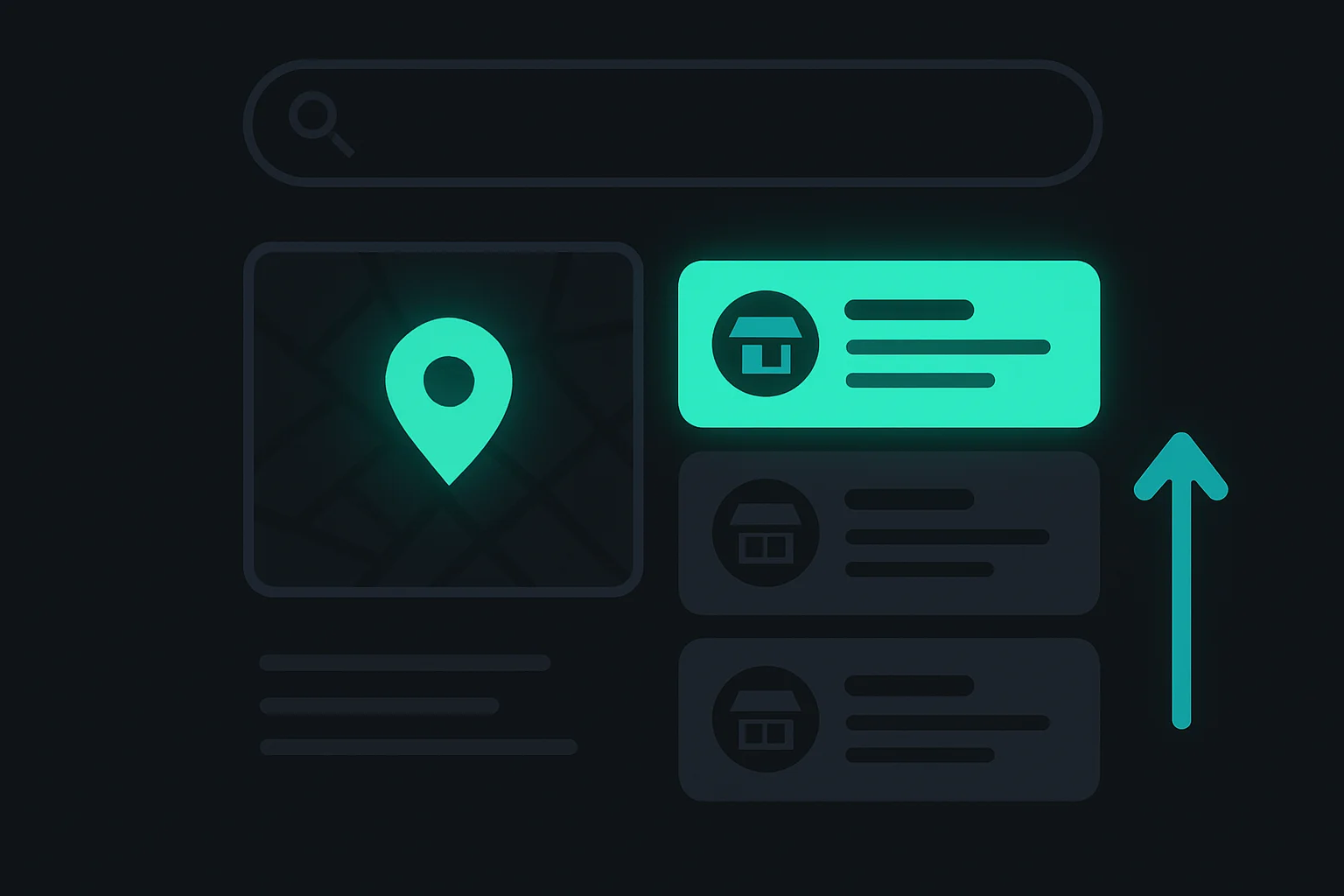
When someone searches "plumber near me" or "best hair salon in [city]," Google shows three businesses at the very top — above every website, above every ad. That's the local 3-pack, and getting into it is the single highest-impact move most local businesses can make.
The businesses in those top 3 spots get the vast majority of clicks. The ones below? Most people never scroll to them. This guide breaks down exactly how Google decides who ranks where — and what you can do to move up.
What's in this guide
How Google ranks local businesses
Google's local ranking algorithm weighs three core factors for every search:
- Relevance — Does your business match what the person searched for?
- Distance — How close are you to the searcher?
- Prominence — How well-known and trusted is your business online?
You can't control distance. But relevance and prominence are entirely within your control — and most businesses are leaving massive ranking points on the table in both areas.
Here are the six factors that move the needle most, ranked by impact.
Business category — the most underrated ranking factor
Your primary Google Business Profile category is one of the strongest relevance signals Google has. If your category doesn't match what people are searching for, you simply won't show up — regardless of how many reviews you have.
Common mistakes:
- Setting "Contractor" when you're specifically a plumber or electrician
- Using a broad category like "Health & Wellness" instead of "Personal Trainer"
- Picking the wrong sub-category because it sounded closer
- Not adding secondary categories for additional services
How to fix it: Go to your GBP dashboard → Edit profile → Business category. Search for the most specific category that matches your core service. Then add secondary categories for every additional service you offer.
Search Google for your top competitor and look at their category. You can see it by clicking their listing and scrolling to "Category." If they're ranking above you, their category selection may be why.
Profile completeness — Google rewards complete listings
Google explicitly says that complete profiles rank higher than incomplete ones. Every empty field is a missed ranking opportunity.
Sections most businesses leave blank:
- Business description — 750 characters to describe what you do and who you serve. Most businesses leave it empty or write two sentences.
- Services list — List every service with a name and description. Each service is a keyword signal.
- Attributes — Things like "women-owned," "wheelchair accessible," "free parking." Google uses these to match searches that include those terms.
- Hours — Including holiday hours. Listings with accurate, current hours get more trust signals.
- Q&A section — Most businesses have zero Q&As. Seed your own — it's a free content field Google indexes.
Reviews — volume, rating, and recency all count
Reviews are the most visible prominence signal Google has. They factor in three ways:
- Volume — More reviews = more trust signals
- Rating — Higher average rating = better ranking (4.0+ is the floor for competitive markets)
- Recency — Google weights recent reviews more heavily than old ones. A business with 5 reviews this month outperforms one with 50 reviews from 2 years ago
The goal isn't a one-time burst — it's consistent, ongoing review velocity. Even 2–4 new reviews per month compounds significantly over a year.
Responding to reviews — both positive and negative — is itself a ranking signal. Google sees responses as proof that you're an active, engaged business owner. Respond to every review within 48 hours.
Your website — the authority signal most people overlook
Google doesn't just look at your GBP listing in isolation. It cross-references your listing against your website to determine how authoritative and trustworthy your business is.
What your website needs to do to support your Maps ranking:
- Mention your city and service area — If your website never mentions the city you serve, Google has weaker evidence that you're actually local
- Match your GBP exactly — Same business name, address, phone number, and services as your listing
- Have a fast load time — Slow sites signal lower quality to Google overall
- Include local schema markup — Structured data that tells Google exactly what your business is, where it is, and what it does
- Have a dedicated page per service — "Plumbing," "Water Heater Repair," "Drain Cleaning" as separate pages beats one generic "Services" page
NAP consistency — the silent ranking killer
NAP stands for Name, Address, Phone. Your business information needs to be identical across every place it appears online — your GBP listing, your website, Yelp, Facebook, Apple Maps, Bing, Angi, industry directories, and anywhere else your business is listed.
Even small differences confuse Google's algorithm:
- "St." vs "Street"
- "Suite 4" vs "#4" vs "Ste. 4"
- Old phone number still on Yelp from 3 years ago
- Business name slightly different across platforms
How to audit it: Search your business name on Google and click through every listing you find. Check that name, address, and phone match exactly. Update any that don't.
Profile activity — Google tracks whether you show up
An abandoned GBP profile ranks lower than an active one. Google interprets activity as a signal that the business is real, open, and engaged with customers.
What counts as activity:
- Adding new photos (aim for at least 2–4 per month)
- Publishing Google Posts (promotions, events, updates)
- Responding to reviews
- Answering questions in Q&A
- Keeping hours updated (especially holidays)
Set a recurring reminder every Monday to do one thing on your GBP — add a photo, write a post, or respond to a review. That's it. Ten minutes a week of consistency compounds faster than any one-time optimization.
Yes, significantly. Google cross-references your GBP listing with your website. If your website doesn't mention the same city, services, and business name as your listing, that inconsistency suppresses your Maps ranking.
Reviews are just one factor. Your competitor may have a more accurate primary category, more complete profile, stronger website signals, or better NAP consistency. A GrowthLeaks audit will show you exactly what's giving them the edge.
Posts are an activity signal — Google sees that your business is active. While posts don't directly boost ranking the way reviews or categories do, consistent posting contributes to overall profile strength.
The local 3-pack is the block of three business listings that appears at the top of Google search results for local queries — above the organic results. Getting into the 3-pack is the single highest-impact move for most local businesses.
Yes, but you're handicapped. Your website is a major authority signal for Google. Businesses with well-optimized websites consistently outrank those without. If you don't have a website, getting one should be a priority.